Son of Louis William Dingeldey
BIRTH: 18 Nov 1905 in Ohio, USA
SCHOOL: East Technical High School 1924
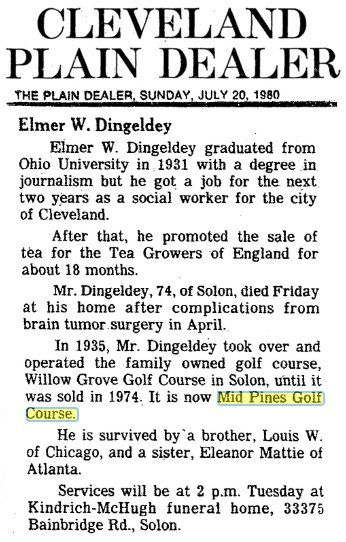
DEATH: 18 Jul 1980 in Solon, Ohio, USA
BURIAL: Lake View Cemetery,Cleveland, Ohio
PLOT: Section 42 Lot 98-0


Elmer was Grandma Mattie’s twin brother; one of three brothers. We don’t have any pictures of him or the farm that I know of. I can tell you what I know about him. Louie Dingeldey was the oldest of the siblings and was trained as a skilled machinist. Elmer and Grandma Mattie were the middle children. Mother had a younger brother whose name I can’t recall. He was a brilliant engineering student at Case-Western University in Cleveland when he died in his 20’s from a congenital heart defect.
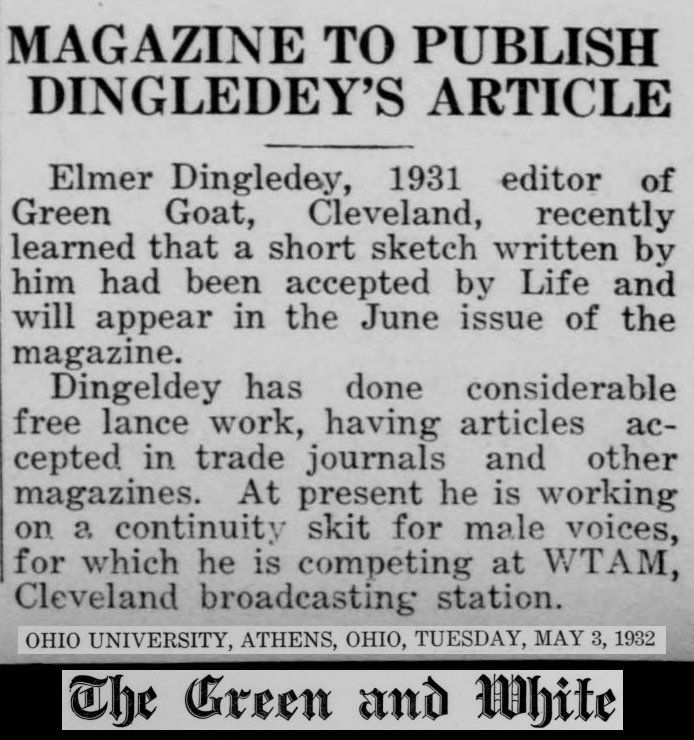
Elmer graduated from college, [Ohio University] with a journalism degree. To the best of my knowledge, he never worked as a journalist. He was a bachelor and lived his entire life with my grandmother, Grandma Annie, on the farm until he died. My great grandfather, who died from a stroke before my time, had a very successful shoe repair business. He was a first-generation German immigrant and one of the first in the country to mechanize the shoe repair business with machines he imported from Germany. I believe that the farm was a second home. After he died, it became apparent that farming was not financially viable. It was Elmer’s idea to turn it into a nine-hole golf course. (If I recall correctly, the farm was approximately 150 acres and not large enough for a full 18-hole course) The barn was turned into a clubhouse and Elmer spent the rest of his life managing the business, which, I understand was, financially, a break-even at best.
Elmer, as you might suspect, was a very strange duck. In his spare time, he taught himself to play the organ and amassed a world-class collection of classical music records, which he played on a state-of-the-art stereo system. Your father and I would drive him nuts when we visited Grandma Annie. On more than one occasion, we botched up his stereo system.
Elmer dated one girl most of his life. I was told that they never married because she was Catholic and for some reason would not marry Elmer because he was not Catholic and would not become a Catholic.
When Grandma Annie died, she left the farm to Elmer, which was appropriate. Tragically, however, when Elmer died, he left everything to his girlfriend. Grandma Mattie did not get so much as a keepsake. She was devastated. After Elmer died, we lost track of the farm. I understand that it was sold and developed into a residential project.
Written history from Ken Mattie, nephew of Elmer Dingeldey, and son of Eleanor Marie [Dingeldey] Mattie
"I worked there one summer during the mid-60’s when it was known as Willow Grove. Oh, could I tell stories. Owner would have me water greens with a hand hose at High Noon. Lol. He, um, was very, very, very cost conscience. Lol!
The owner, Mr. Dinglebee, if that was really his name, invited a bit of adolescent mocking. No excuse. It was immature and not Christian-like. It wasn't so much his name, tempting as it was. It was his penchant for taking naps in a hammock inside the barn loft. It was him being so cheap. Lol. The story that comes to mind is one that got me a lecture. I had read that water crystals magnify the sun, especially at noon and early afternoon. He'd have me use a garden hose at those times, watering greens. Naturally, they would turn brown. In a shy way, I questioned him. Yipes! Lol! It was if I had usurped his authority and insulted his intelligence. Having Hitler as a foster father conditioned me, so it didn't bother me too much. Lol. He gave me a sleeve of Spalding golf balls. THREE whole balls - to use during a Plain Dealer Junior Tournament at Manakiki in Willoughby. I finished with one ball, which was a 40-foot snake putt on the final hole. Kept it for years. Sentimental me. Ya, he was a crotchety old man who lived in the nearby house smothered in bushes. But, he gave me a job. My favorite memory was driving the rickety old tractor with him chasing me down dirt-blown fairways in what I believe was his old Buick."
John Klein
On The Road With… By Skip Schweitzer
A Good Day in the Model A
October, 2021
Today I am driving my 1930 Model “A” about the countryside. I stay out of the city traffic. Ninety-year-old cars aren’t made for high speed, bumper to bumper turmoil, and quick stops. It’s a crisp early October morning, maybe 55 degrees. The trees have not yet begun to turn. Everything is still bright and green with just a hint of red and orange here and there. I don’t have the windows open, nor the windshield. It’s a little bit too cold for that. Maybe later when it warms up. There’s nothing like chugging along at 45 MPH looking out the front window of a Model “A”, complete with windshield wiper at half mast, side wind wings and mirrors gleaming, and the chrome quail capping off the radiator. Does it get any better than this? Where’d this all begin? Well, I’ll just tell ya. Way back in ’64……….that’s 19 and 64, I began to work for Elmer Dingledey at a place called Willow Grove Golf Course which, predictably, is now a housing development. Some referred to it as Hacker’s Grove. We two workers referred to it as Elmer’s Funny Farm. (Elmer was a bit of an oddball!) It was diagonally across from the Grantwood Golf Course in Solon, on the southeast quadrant of the intersection of Pettibone Road and Route 43. Back then it was just Aurora Road. It originated in Maple Heights driving south from Rt 8, Northfield Road. I remember there was a new drive-in restaurant called the El Dorado right there at the intersection. They made good high stack hamburgers with lots of gooey sauce on them. Across from it was the Race Horse Tavern, one of my father’s favorite haunts. Oh, I’d been in there plenty of times with him. “Give him a coke and he’ll sit in the back”, he said to the bartender. Boy, I’d heard that line many a times as a kid, “give the kid a coke and he’ll sit by the pin ball machine, or bowling game”. (I never got the quarters to play those machines though.) Heck, I’d heard that many a times at Grantwood Golf Course after caddying for him on Tuesday nights at the Pesco golf league (He worked at Pesco Products, a large machine shop). “Here’s fifty cents, get yourself a milk shake and sit over there while I have a beer with the boys”. I always got a Mars bar with the left over 15 cents. Those were good times with my Dad. But I’m getting side-tracked. Willow Grove was a place that I worked for during the summer after graduation from High School and before I went to Ohio University in Athens, Ohio. Elmer Dingeldey, the owner, was in his 80’s by then—too old to run the longoutdated golf course machinery, so he hired a couple boys to do the work for him. Elmer just sat in the “Pro Shop” -- I use the words loosely. It was actually the corner of the upper barn, complete with well-worn wooden planks for floors, hay forks on the wall, and grass seed, fertilizer, and hay stacked in another corner. There was a modern department store counter of sorts, no doubt procured at an auction and greatly out of place in this barn, where you checked in and paid your $3 for a round of golf. Every morning at 8 AM we two boys would rouse Elmer from his kitchen at the house down from the barn and get our orders for the day. “Take the mower and gang reels and cut the fairways on holes 1,2,3,4. Take the power reel mower and cut all the greens—you have to cut them real short or the golfers b……(rhymes with itch) complain bitterly. We don’t want them going over to Grantwood, do we. Take the Ford tractor with the brush hog on it and knock down the brush around the 6th hole—it’s gotten too high; they lose their balls in it, ha, ha, ha. If you find any bring ‘em back here to the shop and we’ll sell ‘em back to ‘em. Take the jeep and gang mowers and cut the fairways along holes 8 and 9. Take the thig-a-ma-jig and relocate the holes on the greens where there is too much wear on the creeping bent. Be sure to carefully put the grass plug back over the old hole so as not to disturb their putts, ha, ha, ha. We wouldn’t want to do that now, would we? Turn on the pump and water the greens. They’re looking a little brown. And don’t leave the hoses out like you did last time—chuckling-- the con-sarned- golfers drink out of ‘em. (The water came from an algae covered pond near the barn, Aaarrrgh)”. Elmer had a bit of a mean streak! So it went for the whole summer. Not a bad job for a 17-year-old kid…. get your orders for the day, go do your thing for the rest of the day. I think we made $1.25 per hour. Life should be that easy now. You’re probably wondering, how does all this relate to Model “A” Fords. This wasn’t actually the very beginning of my interest in Model “A” Fords. That began back as early as I can remember with my Dad talking to my grandfather about Model “A”s. It seems that Model “A”s were their favorite cars back in their day. They both had them and drove them throughout the depression until the war ended. Then Grandpa Charley got a spiffy new 1950 Mercury and Dad got a new 1948 Pontiac that turned out to be not so spiffy. Shortly thereafter he returned to Fords. Back at Willow Grove the extremely well-used, no, borderline junk 1946 Civilian Jeep with no floorboards left and one rear spring still connected to the frame was always parked in the lower barn next to what was left of a Model “A”—no doubt used to extinction on the golf course maintenance. It did not, could not, run. There wasn’t enough left of it to run, with just a little more than a firewall and some body and mechanical components on a frame. I desperately wanted that hulk to build a hot rod, but Elmer wouldn’t depart with it—some sentimental feelings about it I guess. But out in the field that, in better times, was a driving range next to the barn was another hulk, a chassis really, just a frame and motor and running gear from a Model “A”. Sure, I could have it, go get it…Good--riddance. All it ever was, for the past 20 years, was a target for golfers at the driving range till that got overgrown. You bet I brought it home much to my mother’s great dismay. It was my first Model “A”. “Junk, you’re bringing home junk. What will the relatives think? Get that out of here, now”. “OK, I’m likely going into the Navy soon. I’ll disassemble it and put it under the porch. I’m going to build it into a car, a hot rod when I get out”. (I’d been dreaming about this since I was 10 years old). Mother never compromised with any of us in that household. It was her way or the highway! As soon as I went into the Navy, she called the junk man and had it taken away. Such was the ongoing saga of my continuously and progressively deteriorating relationship with my mother. Dad, where are you? Save me here! No, he couldn’t. He was at the Race Horse tavern. Me? I took the highway. But I sense that Dad is always with me now in my Model “A”. So is Charley
-Skip
The Old Road… Summer of “64"
by Skip Schweitzer
October 14, 2022
It was the summer of 1964, the year that I graduated from Maple Heights high school. I was 17, one of the youngest in my class. So, what had I been doing for that past year and a half to make money to pay for gas, cars and parts and what-nots that a typical teenager would need? Oh, I had been cutting grass in the neighborhood since I was 13. Earlier in the year I had been working selling Christmas trees at Highland Driving Range which, as the spring took hold, progressed to occasional weekends cutting grass and picking up golf balls. There was a tractor driven machine that automatically did that but only the owner’s son, inept Seymore, was allowed to use it. The rest of us who worked there had to pick them up by hand. The owner was not a pleasant man to work for. He would issue nonsensical, condescending orders on a daily basis. One day I laughed at one of these. I got fired.
Girls…… had just entered the picture. Yes, I went to the prom, but with a neighbor girl I hardly knew. It was just somebody to go with. I wasn’t into the movie culture at all! Yes, you went to the drive in to see them but you rarely watched the movie now did you! I had cars since before I was old enough to legally drive them, because I could fix them. My mother, with whom I had a looooong ongoing lukewarm/to worse relationship made me sell my cars as soon as I fixed them up. “You have to save money for college”, she said. “Get another car to work on, fix up and sell. Actually, I needed to make more money to go over to my friend Don’s house (a friendlier place to be than home), and oh, did I mention that there was a girl named Sandy living next door to him?” Enter girls from that point on in my life which accelerated the rapidly increasing distance between my mother and me. Sandy was the light of my life for the next year.
Down the road I went toward Aurora in search of a steady job. There were golf courses out that way; maybe I could get a job caddying or cutting grass or who knows what. I was familiar with golfing and courses by this time, having caddied for my father for the past many years if you want to call dragging the golf bag around, perusing the water holes and roughs for golf balls, all for the pay of a milk shake and a Mars candy bar. Caddying, I was with him and away from her. A Titleist or Maxfly was always a great find but the vast majority were cheap no-names that you used around water holes. No need to shoot a good $3 Titleist into the water or mud.
My first stop was Hawthorne Valley in Solon, a ritzy golf club by 1964 standards. They only wanted caddies and you had to have a reputation locally to get picked by the well-heeled golfers. Waste of time! The next place down the line was Grantwood at the Solon-Aurora line. This is where I caddied for my Dad, so I knew the course well. Alas, the greens keepers and grounds men were all long-time older employees. Not much chance there either! Next up across from Grantwood was Willow Grove, or as the guys in my Dad’s league called it, Hackers Grove. When you’re desperate, you do things you might not usually consider doing. I went up to the Hackers Grove barn/clubhouse. There I met Elmer Dingeldey, a tall, thin, pleasant older gentleman sitting behind a makeshift counter. In my minds-eye I seem to remember it as hay bales with some boards laid across it, but I suspect that is a figment of my imagination. It was probably an old display case or restaurant counter in the corner. There were, however, hay bales in another corner.
“Sir, I’ve worked at driving ranges, caddied at Grantwood, and have been cutting grass all my life. I can take apart cars and put them back together and get them running. Do you need a good worker here?” Well, either that dazzled him, or more likely he was hard up and desperate for workers, so he hired me. He also said that if I had any other friends, please bring them along. Next day I brought my friend Rich with me and Elmer hired him too. The daily schedule was to meet him at his house down from the barn at 8 AM and get the chores of the day-what needed to be done. We then went to the lower level of the barn and got out the implements—the motor pool if you will which included old push mowers, reel mowers, and other motorized odd contraptions related to golf courses. The vehicles consisted of a non-running, cut down Model “A”, a non-running non-descript tractor of some make I had never heard of, a roached out 1946 Army Jeep that did run but had no windshield, one seat, one functional rear spring on the left side and a 2×4 wedged in between the axle and rear frame on the right, the rear shackle and part of that spring having long ago parted ways with the Jeep. “Tune up the Jeep, that’s what we pull the gang mowers with and how we get the greens mowers to the greens,” said Elmer! Right, is this really the way we won the war?? Up to that point in my father’s world everything had to be done right, fixed perfectly, everything so-so, not like this! I put new points and a condenser in the Jeep and cleaned the plugs. It purred.
There was also a Massy Ferguson tractor in reasonably good condition with a brush hog on the back and was used mostly to keep the roughs under control. Obviously it hadn’t been getting much use of late since the roughs could better be described as jungles or aspiring forests, and the fairways were getting narrower and narrower perhaps soon to be better described as bowling alleys. “Widen out those fairways with the Ferguson and then go over them with gang mowers. And move the holes on number three and five.” What the hell did that mean? I soon found out. After cutting the grass on the green with a fancy reel mower, a special hole digger machine carefully and cleanly placed the new hole on another part of the green less traveled. The corresponding plug was placed in the old hole. Apparently you had to do this regularly to keep the creeping bent on the greens in reasonable shape.
On a typical day my orders were something like; “cut the fairways on number one and two with the Jeep. That’ll take you a while. Rich, take the Ferguson and start mowing the roughs on number 5. That is a real mess. And start the pumps up by the pond and water the greens around it.” Rich was not great with the tractor and not mechanically inclined either. Frequently he got it hung up with a tree between the front and rear wheels. I had to work it back and forth slowly until I could get it free of the tree. Rich also got logs and large limbs stuck in the brush hog which took a bit of ingenuity to extricate. We usually did that at the back end of the course so no one would notice. The back end of the course bordered Reminderville and there were more than occasional complaints about the Reminderville kids stealing the golf balls.
My most memorable experience while at Willow Grove? I guess that is where and when I got my first Model “A”. No, not the non-running cut down “A” in the bottom of the barn. This one was in a field. In the remains of what was once a driving range on the east side of the property up near the highway was the skeleton of an automobile forlornly sitting there.
There it was, the future car of my dreams sitting in Elmer Dingledey’s field. Well, toward the end of the summer I decided that I had to have it and Elmer said, “Good riddance, take it!” I got it home, disassembled it and stuffed it in the corner of the garage. It took my mother a while to notice it, but finally came the inevitable, “what in the hell did you bring that piece of junk home for?” “I’ll put it under the porch. Someday I’m going to build it into a hot rod”, I said. My father was somewhat amused. All he said was, “Yep, that’s a real Model “A” chassis.” It stayed under the porch for another couple years until I went into the Navy. Then it disappeared. It was the first of my many later Model “A”s.